

AEO 101: A Beginner's Guide to the Critical Steps
Posted in: Search Engine Optimization · Strategy · AI
Posted by: Corey Smith on June 9, 2026 at 09:31 am
Answer engine optimization, or AEO, sounds like another shiny acronym marketers are supposed to chase. I get the temptation to roll your eyes a little. SEO was already hard enough before AI Overviews, AI Mode, ChatGPT, Perplexity, and every other answer-shaped interface started changing how people research.
But the useful version of AEO is not mysterious. It is about making your business easier to understand, easier to verify, and easier to cite when someone asks a specific question. If SEO helps search engines find and interpret your content, AEO pushes you to make the answer itself clearer.
That does not mean you should build only for machines. Google's guidance for AI features in Search says the same SEO foundations still matter for AI features, and that there are no special technical requirements just for AI Overviews or AI Mode. That is good news. It means the work starts with better content, stronger trust signals, and cleaner technical execution.
The best AEO work is part content strategy and part technical hygiene. One side explains the answer. The other side helps systems understand, access, and validate it. If either side is weak, your content may still exist, but it will be harder for answer engines and buyers to use.
Quick Answer: What is AEO?
AEO means structuring your content so answer engines can understand the question, extract the useful answer, and verify why your business is a credible source. It is not a replacement for SEO. It is a sharper way to make your expertise easier to find, trust, and cite.
The best beginner approach is simple: answer the buyer's question clearly, support the answer with proof and context, connect it to related content, and make sure the page can be crawled, indexed, understood, and measured.
The Beginner's Version of AEO
AEO is the practice of preparing your content so answer engines can understand the question, extract the useful answer, and connect that answer to credible supporting context. That context may come from your website, your author information, your topic cluster, your structured data, your internal links, or credible third-party signals. None of those pieces is magic on its own.
Think of AEO as building a better case file for your expertise. A buyer may ask one simple question, but the answer engine may look for context, authority, corroboration, and sentiment before deciding what to summarize. That is why thin pages with generic definitions usually do not hold up very well.
For Smithworks, the right AEO mindset is practical. Start by answering real buyer questions. Then make those answers easier to find, easier to trust, and easier to connect to the broader marketing system. That is the bridge between AEO and the existing Smithworks SEO/AEO cluster around SEO tasks for small business, topic clusters, content refresh, and E-E-A-T.
The steps below are ordered from easiest to hardest. That does not mean the first steps are unimportant. It means most businesses can begin them without a developer, a full website rebuild, or three meetings where everyone agrees to "circle back later."
What Does AEO Look Like When Done Right?
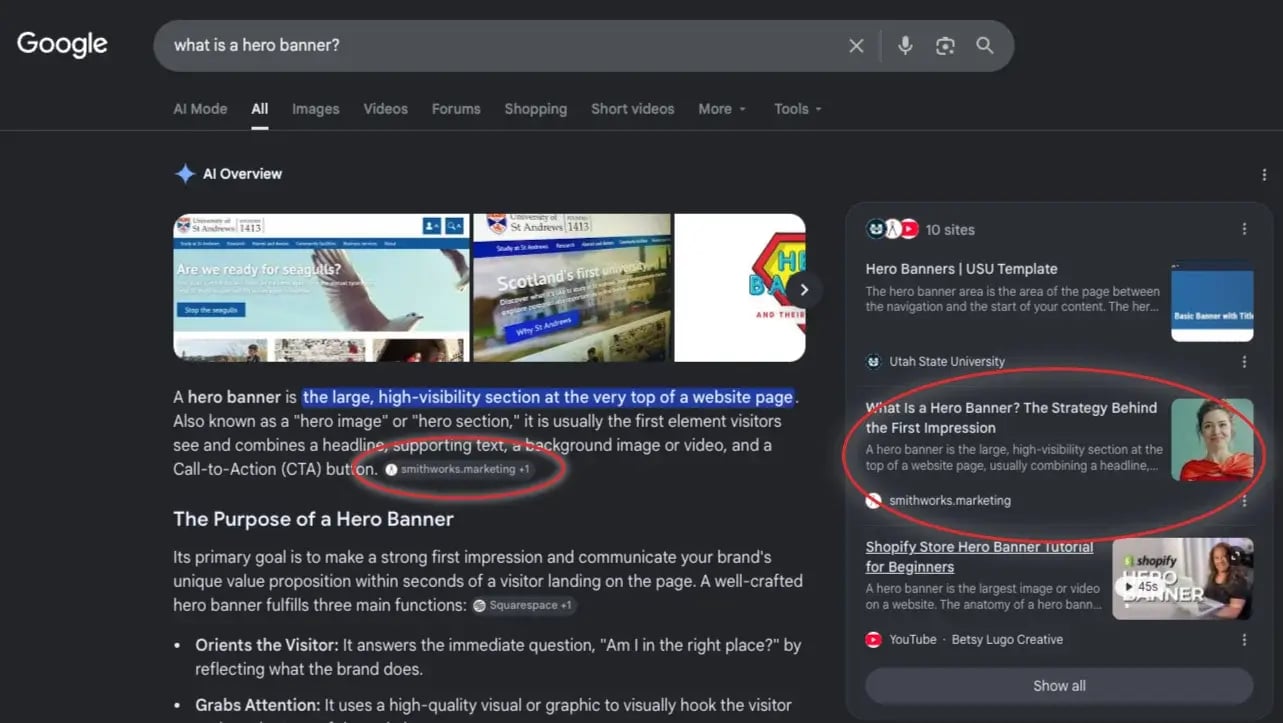
My experience has been that when you do AEO propertly, you'll likely see results in the answer engines faster than you might see in the search engines. My example below showed results for my post on Hero Banners in less than 36 hours. That's pretty good in my book. I even found that when just asking various answer engines about who my companies, I was seeing it find my content updates in less than an hour.
Answer engines are looking for the most recent and relevant data to provide their users and there is a strong push to ensure that the information is as accurate and up to date as possible.
The AEO Readiness Stack
Before you work through the checklist, it helps to see the whole system. The AEO Readiness Stack is a simple way to separate the work without disconnecting it.
| Layer | Content question | Technical question |
|---|---|---|
| Answer clarity | Does the page answer a real buyer question directly? | Is the answer visible in crawlable text? |
| Trust signals | Does the page show experience, proof, and useful context? | Are author, organization, and source signals easy to verify? |
| Topic depth | Does the page connect to related questions and next steps? | Do internal links and site structure support that connection? |
| Technical access | Is the page built around one clear topic? | Can it be crawled, indexed, shown with snippets, and validated? |
| Measurement loop | Can the answer improve as buyer questions change? | Can performance be reviewed through Search Console, analytics, and content workflows? |
That stack is why AEO is not only a writing task or only a development task. The answer has to be worth citing, and the site has to make the answer easy to access and understand.
Five content steps for AEO, easiest to hardest
Content is the first place to start because answer engines need something worth answering with. Technical cleanup can help systems read the page, but it cannot turn weak thinking into useful expertise. If your page does not clearly answer the question, the rest of the AEO stack has very little to amplify.
These five content steps move from simple editorial improvements to harder strategic work. The early steps can often be handled during a content refresh. The later steps require sharper positioning, better cross-linking, and more discipline about what your site is actually trying to be known for.
1. Put the direct answer near the top
The easiest content improvement is to answer the main question early. If the post is about what AEO is, say what it is. If the page explains whether HubSpot workflows should be automated, answer that before wandering through every possible edge case. (I hope it's obvious that your products or services should be replaced with mine from the example.)
This does not mean every page needs a stiff definition block. It means the reader should not have to dig through six paragraphs of setup before finding the point. A good answer-first section helps people, search engines, and AI systems understand the page faster.
2. Rewrite headings around real buyer questions
Headings are not just formatting. They tell readers what problem each section solves. They also help search engines and answer engines understand the structure of the page.
The easiest heading fix is to replace clever but vague headings with clear, human ones. "The Real Issue" may sound dramatic, but "Why AEO Starts With Better Buyer Questions" tells the reader what they are about to learn. Clear does not have to mean boring. It just has to mean useful.
3. Add proof, experience, and useful context
AEO needs more than short answers. It needs trustworthy answers. Google's people-first content guidance emphasizes helpful, reliable content that shows experience, expertise, authoritativeness, and trust, which is usually shortened to E-E-A-T.
For your content, that means adding the practical judgment behind the answer. Explain when the advice applies, when it does not, and what a business owner should watch for. If you are making a technical or platform claim, link to the primary source. If you are building deeper trust content, connect it to related resources like E-E-A-T and SEO trust signals.
4. Build topic clusters around the answer
A single answer can be helpful, but a connected cluster is stronger. AEO benefits when a site has related pages that explain the surrounding topic from multiple angles. That is why a post about AEO should connect naturally to authority building topic clusters, content refresh, E-E-A-T, and ongoing SEO tasks.
This is where many SMB websites get thin. They publish one post about a topic, then expect it to carry the whole conversation. A better cluster gives the reader a path: beginner explanation, tactical checklist, deeper strategy, related service, and practical next step.
5. Create original frameworks, not generic summaries
The hardest content step is also the most important. Answer engines do not need another generic summary of what everyone else already said. Your buyers do not need that either.
Original frameworks give your content something worth citing. A framework might be a decision tree, a checklist, a maturity model, a comparison table, or a named method for diagnosing a problem. AI can help sort, summarize, and pressure-test ideas, especially if you are thoughtful about using AI for marketing, but it still needs human judgment to turn experience into something original and useful. That is part of why AI still needs your strategy and expertise before it can support content worth trusting. The point is not to invent jargon. The point is to organize your real expertise in a way that makes the answer easier to remember and use.
Five technical steps for AEO, easiest to hardest
Technical AEO is not about tricking answer engines. It is about removing friction. If your content is blocked, slow, poorly structured, missing metadata, or disconnected from your entity signals, systems have to work harder to understand it.
These five technical steps also move from easiest to hardest. Some are basic publishing hygiene. Others may require a developer, CMS knowledge, analytics access, or a deeper technical SEO review. Start with the basics before chasing advanced markup.
1. Confirm the page can be crawled, indexed, and shown with snippets
The easiest technical step is making sure the page is eligible to appear in search at all. Check whether the page is indexable, whether it has an accidental noindex directive, whether the canonical URL is correct, and whether Google can access the content. If the page cannot be crawled and indexed, AEO is already stuck.
This step matters because Google's AI feature guidance says a page must be indexed and eligible to show with a snippet to be eligible as a supporting link in AI Overviews or AI Mode. That does not guarantee inclusion. It just means you are not disqualified by a basic technical problem.
This is also why website rebuilds need SEO planning before launch. A rebuild can quietly create crawl problems, redirect issues, missing content, broken canonicals, or changed URL paths if the technical plan treats SEO as something to clean up after the site is already live.
2. Fix titles, meta descriptions, and visible page structure
Good metadata does not guarantee an answer-engine citation. It does help systems and readers understand what the page is about. A clear title tag, useful meta description, single H1, logical H2s, and visible body content all support the same goal: make the page easy to interpret.
This is also where technical and content work overlap. As an example, if the metadata promises an AEO beginner's guide, the page should actually deliver a beginner's guide. If the H1 says one thing and the body answers another, the page is sending mixed signals.
3. Add appropriate structured data and validate it
Structured data gives search engines explicit clues about the page. Google's structured data documentation explains that structured data helps classify page content, and that it should describe content visible on the page. Do not add markup for information the reader cannot actually see.
For an AEO-focused site, the likely technical priorities are Organization, Person, Article or BlogPosting, BreadcrumbList, FAQPage where visible FAQs exist, and service-related schema where it accurately matches the page. Use Google's Rich Results Test during development and monitor structured data after launch. Markup should clarify the content, not decorate it.
4. Strengthen entity signals across the site
Entity signals help systems understand who the company is, who the author is, what services the business provides, and how those pieces connect. This includes consistent company information, author pages, service pages, social profile links, organization markup, and clear references between related pages.
This is harder because it requires consistency across the website, not just one blog post. A post can say Corey Smith has deep HubSpot and website strategy experience, but the site should also make that background easy to verify. If your company, author, service, and topic signals are scattered, answer engines may struggle to connect the dots.
5. Build an answer hub and measurement loop
The hardest technical step is building a repeatable system. That may include a HubDB-backed central FAQ hub (for example, Smithworks has a central FAQ hub humans and AI agents can both use), reusable FAQ modules (the FAQs on this page are using one such module), related-post fields, structured content models, Search Console review, analytics reporting, and a workflow for refreshing pages as buyer questions change.
This is where AEO stops being a one-time optimization task. The site needs a way to publish clear answers, connect them to related content, measure whether they are getting visibility, and improve them over time. That kind of loop supports AEO, SEO, sales enablement, and content operations at the same time.
What should your next move be?
If you are just starting with AEO, do not begin with advanced schema or a full technical overhaul. Start with one high-value topic where buyers already ask questions. Improve the answer, improve the headings, add source-backed context, connect it to related content, and then make sure the page is technically eligible to be found.
After that, build outward. Refresh the related posts. Strengthen the topic cluster. Add the markup that accurately fits the visible content. Review Search Console and sales conversations for the questions people still ask after reading. That is how AEO becomes a marketing system instead of a checklist taped to a wall.
The good news is that this work is not separate from good marketing. Clearer answers help buyers. Stronger structure helps search. Better technical hygiene helps the site. If your content is scattered, unclear, or hard to verify, AEO is not asking you to do something strange. It is asking you to make the useful parts of your expertise easier to find.
Frequently Asked Questions About AEO
AEO creates a lot of reasonable questions because it sits between content strategy, SEO, AI search, and technical website structure. The idea can sound more complicated than it really is, especially when every new search feature seems to come with another acronym.
The questions below clarify the practical decisions behind AEO: what it is, how it relates to SEO, where to start, and when technical work like structured data actually matters.
What is answer engine optimization (AEO)?
Answer engine optimization, or AEO, is the practice of making your content easier for search engines, AI-generated search experiences, and assistants to understand and use when forming an answer. That usually means answering real questions clearly, organizing the supporting context, and making important claims easy to verify. The goal is to make your content eligible and useful for these experiences. AEO cannot guarantee that a platform will include or cite your page.
Related Posts: Build Authority with Topic Clusters · Mastering Google's E-E-A-T for Better SEO
How is answer engine optimization different from SEO?
Answer engine optimization, or AEO, is part of a broader search strategy, not a replacement for SEO. Both depend on useful content, clear organization, credible evidence, and a website that search systems can access.
- SEO focuses broadly on helping people find your content through organic search and measuring visibility, traffic, engagement, and conversions.
- AEO puts extra emphasis on direct questions, concise answers, and supporting evidence that search and AI systems can use in summaries and generated answers.
You cannot control whether an answer engine cites your page. Measure the search visibility, website visits, and business results you can verify.
Related Posts: 11 Essential SEO Tasks to Keep Your Business Ahead of Competitors · Build Authority with Topic Clusters
What is a practical first step in AEO?
Start by identifying a real question your audience asks and confirming what the person is trying to accomplish. Then give a concise, direct answer in a prominent place on the page. Follow that answer with useful context, evidence, examples, and a practical next step. This is a strong first content step, but it works best after question and intent research rather than as a shortcut around it.
Related Posts: Using AI for Marketing: Top Five Things Every Marketer Should Know · The Fallacy of AI: Why It's Brilliant But Still Needs You
Does AEO require structured data?
No. Answer engine optimization (AEO) does not require special structured data for AI. When it is relevant and supported, schema markup can label visible page content in a format search systems understand. It does not guarantee rankings, inclusion in an AI-generated answer, or a citation. Use schema only to describe the content accurately, not to make claims the page cannot support.
Related Posts: Rebuilding Your Website with SEO in Mind

About Corey Smith
Ready to simplify and succeed? Let’s make it happen—because your business deserves practical, no-nonsense wins. Find me on LinkedIn.