
No. The work follows the agreed priorities and available capacity. The Annual Marketing Plan and Quarterly Work Plans define the deliverables, responsibilities, and sequence. The capability groups describe the kinds of work we can draw from; they are not a promise to deliver every capability in every sprint.
How marketing sprints work
Marketing sprints focus the work around the problem that matters most.
Turn one approved priority into a scoped plan, coordinated work, visible evidence, and a clear next decision.
A marketing sprint is not a random list of tasks.
It begins with the business problem or opportunity that deserves attention now. We scope the work around an agreed outcome, clear ownership, visible dependencies, and the evidence needed to decide what comes next.
For the service overview, explore Strategic Marketing.
Not a request queue
Unrelated requests compete for attention, and progress is hard to judge.
A focused decision cycle
One priority moves through coordinated work, review, evidence, and a clear next decision.
Annual planning cadence
How planning continues while work is underway.
The Annual Marketing Plan establishes direction and the first Quarterly Work Plan. During each quarter, approved work continues while we review evidence and shape the next plan. Planning stays connected to what we learn from execution.
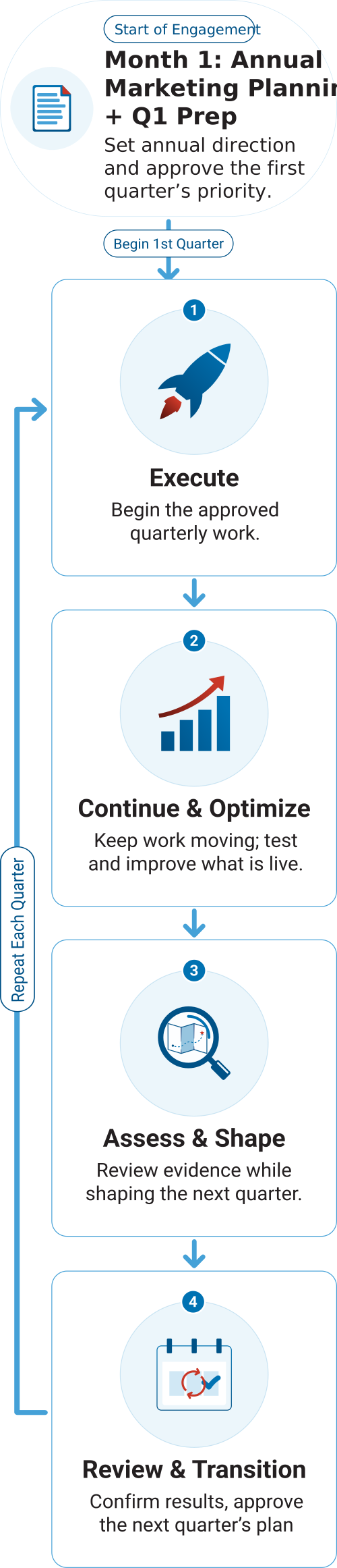
The Forged Marketing System guides the full cadence. Refinement happens through execution and optimization; assessment and shaping use current evidence to set the next priority.
Start of Engagement. Month 1: Annual Marketing Planning and Q1 Prep. Set annual direction and approve the first quarter’s priority.
Begin 1st Quarter. 1. Execute. Begin the approved quarterly work. 2. Continue and Optimize. Keep work moving; test and improve what is live. 3. Assess and Shape. Review evidence while shaping the next quarter. 4. Review and Transition. Confirm results, approve the next quarter’s plan.
Repeat Each Quarter. During Q4, Assess and Shape also refreshes the Annual Marketing Plan and shapes next year’s first quarterly work plan. The Q4 callout is intentionally absent from the small diagram.
One coordinated marketing system
Same capabilities. Different pace.
The work is defined by your priorities and available capacity, rather than a preset bundle of monthly deliverables. The Annual Marketing Plan sets the direction; each Quarterly Work Plan identifies the deliverables, responsibilities, and sequence. That can involve practical work across the capabilities below.
Strategy, planning + content
Annual direction, quarterly priorities, messaging, articles, offers, and creative.
Social + distribution
Publishing, audience development, engagement, promotion, and distribution.
Search, websites + conversion
Research, optimization, technical improvements, landing pages, and conversion work.
Digital advertising
Paid search, retargeting, campaign testing, and optimization.
Email + lifecycle
Campaigns, nurture sequences, newsletters, segmentation, and lifecycle communication.
CRM, sales enablement + reporting
CRM, automation, sales sequences, handoffs, reporting, testing, and improvement.

Investment determines how much can move at once. The Quarterly Work Plan determines what moves first.
Lower capacity
Fewer priorities move at once. Work is sequenced across a longer roadmap.
Greater capacity
More work can move in parallel. The system and available capabilities stay the same.
Available capabilities do not mean unlimited simultaneous production. Media spend, software, and major outside production may remain separate; inclusion is defined in the engagement scope.
Working relationship
Clear decision rights keep a sprint moving.
Work slows when access, review, or approval is unclear. The plan names who owns each decision, what we need from your team, and how blockers will be handled.
Smithworks leads
Assessment, planning, coordination, agreed execution, measurement, and the recommendation for what comes next.
Your team supplies
Business context, access, subject-matter input, reviews, approvals, and timely decisions.
The process protects
One agreed priority, visible blockers, clear scope, and a review based on evidence.
What you receive
Planning creates the roadmap. Sprints move it.
Annual Marketing Plan
Establishes goals, buyers, priorities, measures, major initiatives, constraints, and the roadmap that quarterly planning will refine.
Quarterly Work Plan
Confirms the next priority, exact deliverables, responsibilities, sequence, dependencies, approvals, and available capacity.
Sprint close
Records completed or launched work, performance evidence, documented learning, and the recommendation for the next decision.
Questions about marketing sprints
Marketing work is planned and reviewed on a quarterly cadence. The Quarterly Work Plan defines the priority and work to move during that period. Specific dates, review points, and capacity are agreed in the engagement plan. The four steps in the diagram describe the cycle; they are not four fixed monthly phases.
Your team provides business context, access, subject-matter input, reviews, approvals, and timely decisions. The plan identifies who owns each decision and what is needed from them so the work can keep moving.
We weigh the new priority against the approved work, dependencies, and available capacity. We decide together what changes, what waits, and what the revised plan needs to show. New requests do not silently expand the scope.
Depending on the agreed scope, a sprint can include planning, content, search, website and conversion work, email, social distribution, advertising, CRM, sales enablement, and reporting. The Quarterly Work Plan identifies which deliverables belong in the current sprint and who is responsible for them.
It can include hands-on execution as well as planning, measurement, and review. The agreed work may include creating content, improving pages, configuring workflows, running campaigns, or building reports. Deliverables and responsibilities are defined in the Quarterly Work Plan.